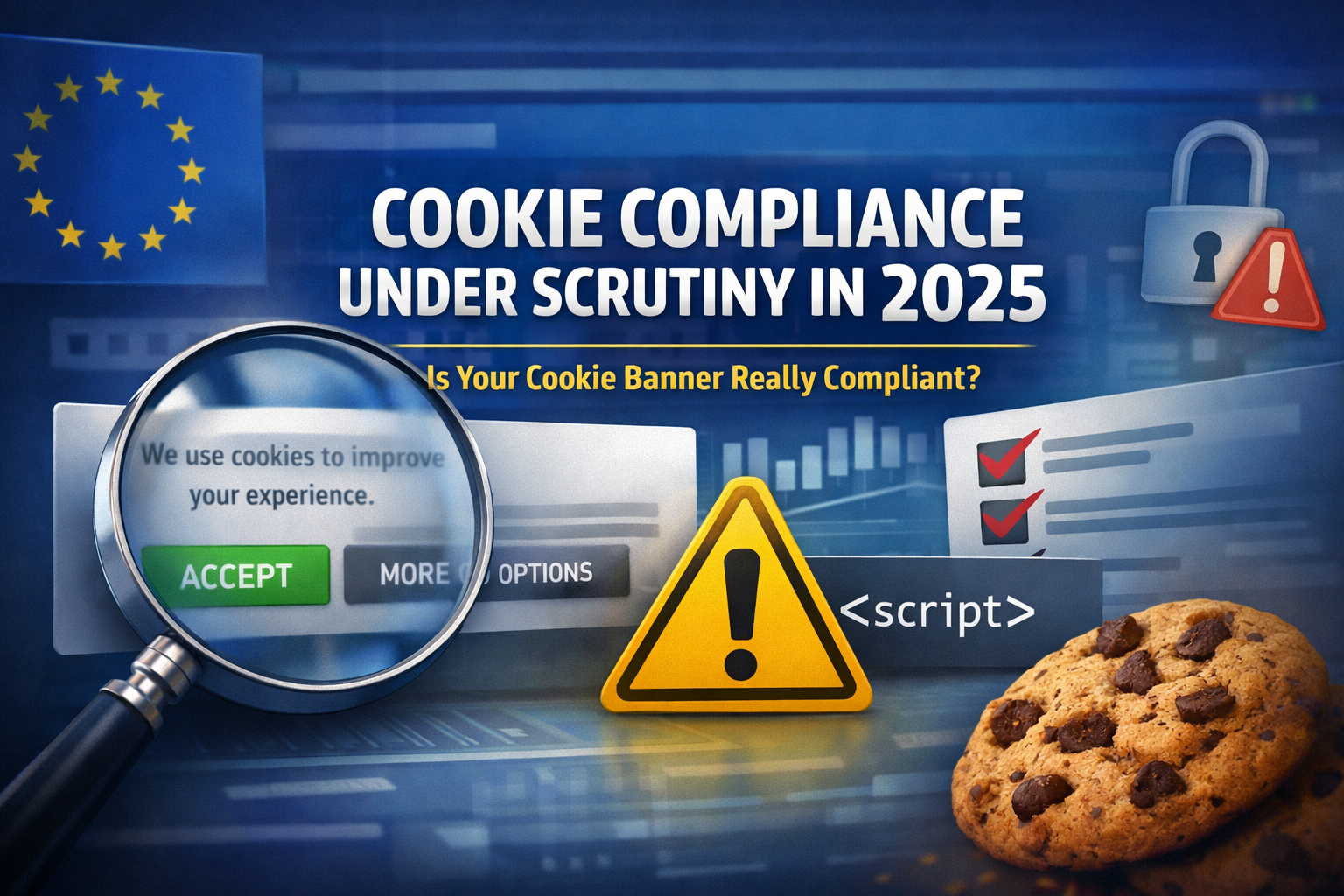
Over the past several months, regulators in the EU and beyond have quietly renewed their focus on one of the most visible (and most misunderstood) parts of website compliance: cookie consent.
While cookie banners never really went away, enforcement trends in late 2024 and early 2025 show a clear shift. Regulators are no longer satisfied with banners that technically exist but don’t actually give users meaningful choice.
What’s changing (and what isn’t)
The laws themselves haven’t suddenly changed. GDPR and similar privacy regulations still require that non-essential cookies are only set after valid consent. What has changed is how strictly regulators are interpreting that requirement.
Authorities are increasingly calling out patterns such as:
- “Accept All” buttons that are more prominent than rejection options
- Consent banners that disappear without an explicit choice
- Analytics or marketing scripts firing before consent is recorded
- “Legitimate interest” being stretched beyond its intended use
In short, dark patterns and shortcuts are being treated less like grey areas and more like violations.
Why this matters for small and mid-sized sites
Historically, enforcement actions focused on large platforms. That’s no longer guaranteed. Regulators are now signaling that systematic non-compliance—even on smaller sites—can trigger warnings, audits, or takedown notices.
For agencies and site owners, this creates a real risk:
- Client trust erosion
- Emergency retrofits after complaints
- Expensive rework of tracking setups that could have been done correctly upfront
The real compliance mistake we keep seeing
The biggest issue isn’t missing a banner—it’s assuming the banner alone equals compliance.
Consent is not just a popup. It’s a system:
- Cookies should not fire until consent is given
- Consent choices must be logged
- Users must be able to change or withdraw consent later
- The site should behave differently based on those choices
If any one of those pieces is missing, the site may still be out of compliance—even if it “looks compliant” on the surface.
What you should do this week
If you manage or maintain a website, now is a good time to:
- Test your site with cookies disabled and see what still loads
- Verify that analytics and marketing scripts are actually blocked before consent
- Review how consent decisions are stored and retrieved
- Confirm that rejecting cookies is just as easy as accepting them
These are practical checks—not legal theory—and they often reveal issues quickly.
Where iCompliancy fits in
At iCompliancy, we’re building tools and guidance focused on operational compliance, not checkbox compliance. That means helping site owners understand what their site is actually doing, not just what a banner claims to do.
As enforcement attention increases, clarity matters more than ever.
We’ll continue monitoring regulatory signals and translating them into actionable guidance—without fearmongering or legal jargon.